
Integrity
How we read WSOP.com's integrity stack from outside
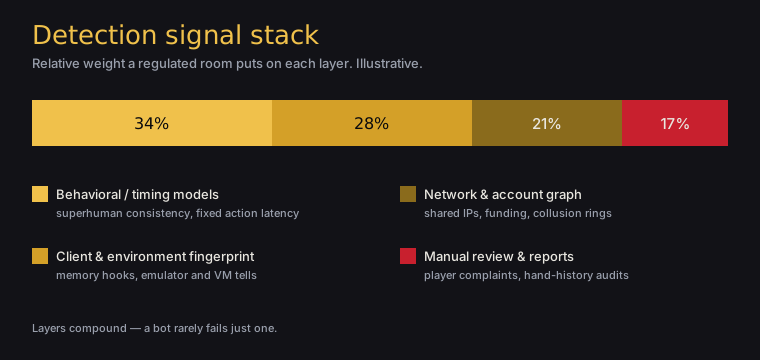
Our working picture: WSOP.com is a regulated US room, which means the integrity team has to defend a license, not a brand. From the bans we have watched and the regulator filings we have read, the stack lines up as four layers — behavioural, environment, network/account graph, and the human reviewer who actually signs the ban. We use this map internally.
On the real-money side, detection is the entire game. Because WSOP.com operates under US gaming regulation, integrity is not optional marketing — it is a licensing obligation. What follows is the general shape of how modern regulated rooms approach automated play. It is descriptive, not a manual: the value is in understanding why no single countermeasure carries the load.
Layer 1 — Behavioral and timing models
The most powerful signal is how an account plays over time. Humans are inconsistent: decision time varies with hand complexity, fatigue shows up over a session, and bet sizing drifts. Bots tend to be too consistent — uniform action latency, identical sizing patterns, and strategy that holds rock-steady across thousands of hands. Statistical models flag accounts whose play is more regular than any human population, and whose win-rate consistency at scale is itself a tell.
Layer 2 — Client and environment fingerprint
Real-money clients inspect the machine they run on. They look for memory-reading hooks, injected processes, automation frameworks, and the signatures of emulators or virtual machines used to run many instances. A bot has to either touch the client's memory or drive it externally, and both leave traces the room can fingerprint. Running twenty "players" off one VM host is convenient for the operator and obvious to the integrity team.
Layer 3 — Network and account graph
Bot operators rarely run one account; the economics demand many. That creates a graph: shared IP ranges, overlapping payment instruments, correlated login times, and the seating patterns of accounts that suspiciously avoid or feed each other. Graph analysis surfaces rings rather than individuals — and once one node is confirmed, the connected accounts inherit suspicion.
Layer 4 — Manual review and player reports
Algorithms triage; humans confirm. Player complaints about a suspiciously machine-like opponent feed a queue where analysts pull full hand histories and look for the things models cannot fully encode — context-blind decisions, impossible reaction sequences, or strategy that no human would sustain. Manual review is the smallest layer by volume but often the decisive one for a ban that must withstand a dispute.
Why the layers compound
The point is not any single layer's accuracy — it is that an operator must beat all of them at once. Humanize the timing and the network graph still betrays the ring. Spread across clean IPs and the client fingerprint still shows the automation harness. Clean the client and the play itself is too perfect. Each defeated layer raises the cost of the next, until the expected value of botting a regulated room falls below the cost of operating undetected. That economic ceiling, not any one detector, is what keeps the game playable.

Raul Moriarty
Poker Software Expert · writes on game integrity and automation.
Question about detection or integrity?
If you are looking into how a room handles automation, or evaluating a claim, reach out and we will walk you through it.
Get in touch